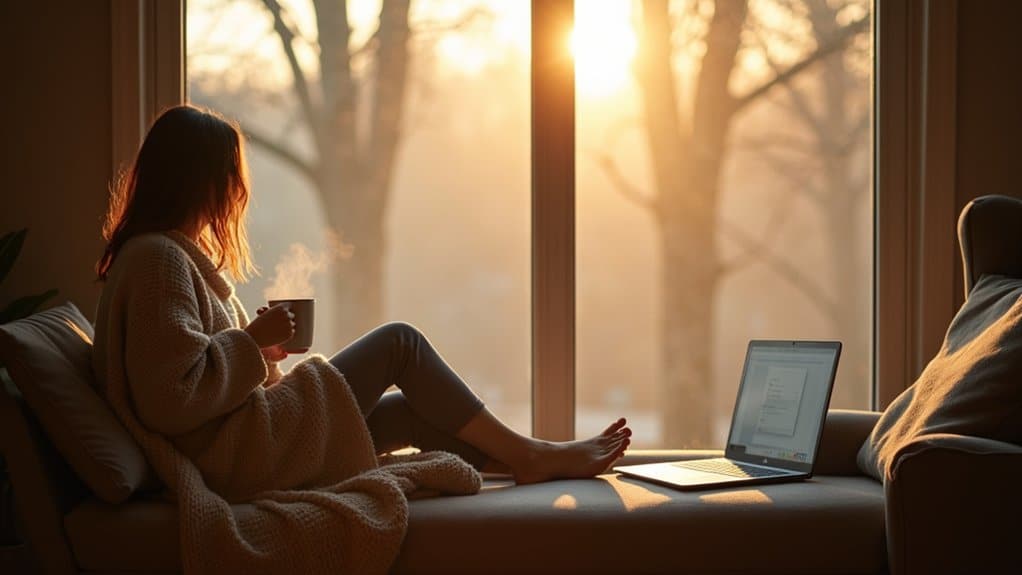
Your lighting choices directly shape how quickly you recover from anxiety. Warm amber light lowers cortisol and activates your parasympathetic nervous system, while fluorescent lighting triggers discomfort in 75% of anxiety patients. Morning natural light suppresses melatonin and supports mood regulation throughout the day, and brighter therapy rooms, at 2,500 to 10,000 lux, boost treatment outcomes by 4.7% per 1,000-lux increase. Understanding which colors, temperatures, and strategies work best can transform your recovery environment into a clinical advantage.
How Lighting Directly Affects Anxiety Recovery
When you step into a room bathed in harsh fluorescent light and immediately feel your shoulders tense, that reaction isn’t just psychological, it’s physiological. Research shows 75% of people with anxiety disorders report discomfort under fluorescent lighting, and nearly 74% attempt to leave fluorescent-lit rooms entirely. Your body’s stress response activates measurably under these conditions.
The connection between lighting and mental health anxiety runs deeper than discomfort. Fluorescent lights increase alertness while suppressing your capacity for relaxation, compounding anxiety’s already heightened alert state. Conversely, amber lighting produces measurable cortisol reductions, while red and infrared light activate your parasympathetic nervous system, directly counteracting the stress response. These aren’t subtle effects; brainwave monitoring confirms observable neural changes corresponding to genuine stress reduction. Researchers hypothesize that amber light’s effectiveness stems from its similarity to natural light, which may tap into deep biological responses that promote calm.
How Color Temperature Shifts Anxiety and Stress
Not all light colors affect your nervous system the same way, and the specific color temperature of your environment plays a measurable role in whether your body shifts toward calm or stays locked in a stress response. Warm light (1,500K, 3,000K) reduces arousal through autonomic indicators like heart rate and galvanic skin response, while cool light (4,500K, 6,500K) drives alertness and focus but can elevate stress with prolonged exposure.
Understanding how lighting affects anxiety recovery starts with recognizing these physiological distinctions. Research from the University of California found amber lighting produced the fastest stress mitigation, lowering cortisol levels more effectively than red, green, or blue alternatives. Curiously, those colors actually slowed stress recovery compared to standard white light. The calming effects of amber light may be rooted in our association with natural light experiences like sunsets, suggesting an evolutionary basis for this response.
Blue, Green, and Red: Which Light Colors Help or Hurt?
Though warm amber lighting leads the pack for rapid stress relief, the individual effects of blue, green, and red light on anxiety aren’t as straightforward as you might expect.
Not all calming colors work the same way, blue, green, and red light each affect anxiety differently than most people assume.
- Blue light accelerates post-stress relaxation roughly three-fold compared to white lighting, with cortisol reductions observed after just 20 minutes of exposure.
- Green light promotes concentration, lowers heart rate, and supports seasonal affective disorder treatment alongside improved memory and mood.
- Red light boosts energy and circulation but can trigger heightened tension in anxiety-prone individuals, requiring careful use.
- Overexposure to blue or green wavelengths risks overstimulation, diminishing their calming benefits.
Understanding each color’s lighting impact on mood and anxiety helps you make informed choices. However, you should integrate color therapy alongside professional treatment rather than as a standalone solution. Research into chromotherapy’s foundations draws from both Newton’s prism experiment and Goethe’s emotional color theory, reinforcing how color influences well-being at a physiological and psychological level.
Why Fluorescent Lights Worsen Anxiety in Most Patients
If you’ve ever felt uneasy under fluorescent lighting, the evidence validates your experience, research shows that 75% of anxiety patients report discomfort under fluorescent lights, compared to just 25% of healthy individuals. This sensitivity can escalate beyond mere discomfort, as fluorescent lighting carries a documented potential to trigger full panic attacks through measurable physiological changes like elevated heart rate and heightened stress responses. Faced with these effects, anxiety patients don’t just endure the environment, studies show they actively attempt adaptation (66.7%) or leave the space entirely (73.7%) at considerably higher rates than non-anxious individuals.
Fluorescent Light Discomfort Rates
Because fluorescent lighting remains the default in many clinics, waiting rooms, and hospitals, most anxiety patients encounter it precisely when they’re at their most vulnerable. Research on fluorescent light discomfort rates reveals striking disparities:
- 75% of anxiety disorder participants reported discomfort with fluorescent clinic lighting, compared to just 25% of healthy controls
- 73.7% of anxiety patients attempted to leave fluorescent-lit rooms
- Patients associate fluorescent lights with “headaches, negativity, and discomfort”
- Exposure increases irritability, depression, and decreased concentration
These numbers confirm that your lighting choices for anxiety recovery matter greatly. When nearly three-quarters of anxiety patients actively try to escape fluorescent environments, you can’t overlook how deeply lighting undermines anxiety recovery. Addressing this single environmental factor could meaningfully reduce distress during treatment. Visual environment and anxiety levels are intricately linked, highlighting the importance of creating spaces that promote calmness. A study indicated that patients exposed to softer, warmer lighting consistently reported lower anxiety scores.
Panic Disorder Sensitivity
Research from the University of Siena links photophobia directly to panic disorder. If you’re affected, you likely shield yourself from bright light instinctively, a response that can escalate into agoraphobia over time.
| Mechanism | Effect on Anxiety |
|---|---|
| Subliminal flicker | Sends chaotic signals to your brain, triggering migraines or seizures |
| Blue light wavelengths | Disrupts sleep patterns, amplifying panic responses |
| Circadian rhythm disruption | Impairs mood and hormone regulation |
| Photophobia activation | Creates avoidance cycles reinforcing anxiety |
Switching to calming lighting for anxiety interrupts these cascading neurological triggers, giving your nervous system space to recover.
Patient Avoidance Behaviors
When fluorescent lights flicker overhead, most anxiety patients don’t just feel uncomfortable, they actively try to escape. Research shows 73.7% of anxiety patients attempt to leave fluorescent-lit rooms, while 75% report significant discomfort under these conditions. You’re not overreacting, your nervous system is responding to a genuine threat.
These avoidance patterns typically manifest as:
- Leaving fluorescent-lit spaces despite social or professional consequences
- Restricting exposure to workplaces, clinics, and academic environments
- Developing anticipatory dread before entering known fluorescent settings
- Reinforcing avoidance cycles that progressively limit daily functioning
Understanding these behaviors validates your experience and opens pathways toward solutions. Prioritizing home lighting for anxiety reduction gives you a controlled environment where recovery can actually begin.
Natural Daylight and Circadian Anxiety Relief
Although you might not think of sunlight as a tool for managing anxiety, your body’s internal clock depends on it to regulate the hormones that shape your mood each day. Light-sensitive cells in your eyes send signals to your brain’s suprachiasmatic nucleus, which orchestrates your circadian rhythm. Morning exposure within 30 minutes of waking suppresses melatonin and raises cortisol appropriately, establishing hormonal conditions that support anxiety management throughout the day.
Research confirms natural daylight anxiety relief isn’t anecdotal. Survey data from 593 adults showed that increased outdoor time and brighter environments greatly reduced anxiety and depression symptoms. Each additional hour in natural light corresponded with decreased long-term depression risk. Even 5-10 minutes of winter daylight surpasses standard indoor lighting, making brief morning exposure a practical, evidence-based strategy for circadian anxiety relief.
Why Brighter Therapy Rooms Boost Outcomes by 4.7
The benefits of natural daylight don’t stop at your morning routine, they extend directly into clinical settings, where the intensity of light in a therapy room measurably shapes your recovery. Research shows brighter therapy rooms within the 2,500, 10,000 lux range enhance therapeutic efficacy, with every 1,000-lux increase boosting outcomes by 4.7%. This ideal light intensity drives serotonin production, directly supporting anxiety reduction and emotional regulation.
Evidence-based lighting design delivers measurable mental health benefits:
- Serotonin elevation promotes stress relief, calmness, and improved concentration
- Ideal ambient lighting accelerates anxiety recovery through neurochemical activation
- Higher lux levels strengthen emotional regulation during therapy sessions
- Intentional lighting design transforms passive environments into active therapeutic tools
You don’t need a complete renovation, strategic adjustments to ambient lighting can meaningfully shift your recovery trajectory.
Warm Evening Light for Sleep and Anxiety Recovery
As evening approaches, just one simple shift in your lighting can set the stage for measurably better sleep and faster anxiety recovery. When you switch to soft, amber-toned light roughly an hour before bed, you’re signaling your brain to boost melatonin production and lower cortisol levels. Clinical measurements confirm amber lighting produces the fastest stress reduction compared to red, green, or blue alternatives.
This warm lighting anxiety support works by aligning your circadian rhythm with natural darkness patterns. You’ll experience longer, deeper sleep and stronger overnight emotional recovery. Cool or bright light, by contrast, suppresses melatonin and stalls relaxation. Consistency matters, maintaining a warm evening lighting routine reinforces healthy circadian habits, steadily improving your sleep regularity and daytime resilience against anxiety.
Let Anxiety Patients Control Their Own Lighting
When anxiety patients can choose their own lighting, their comfort and recovery improve measurably, and the data shows why this matters.
Research reveals that 73.7% of anxiety patients would leave rooms with fluorescent lighting, while 75% reported discomfort under standard clinic fluorescents. These aren’t minor preferences, they’re statistically significant responses (P = 0.007) that directly affect treatment engagement.
Giving you control over your environment changes outcomes. Consider what adjustable lighting enables:
- Dimmable LEDs let you set soft lighting anxiety relief levels tailored to your sensitivity
- Amber light options reduce cortisol and show measurable stress mitigation
- Flicker-free systems eliminate sensory triggers common in fluorescent fixtures
- Personalized color selection supports individualized recovery pathways
Patient-controlled lighting transforms clinical spaces from stress-inducing environments into therapeutic ones that actively support your healing. Creating a trauma recovery safe space promotes emotional healing and fosters resilience. It allows individuals to express their feelings in a supportive environment, facilitating deeper connections with their experiences.
A Room-by-Room Lighting Plan for Treatment Spaces
Designing each room in a treatment facility with intentional lighting isn’t just an aesthetic choice, it’s a clinical one that directly shapes anxiety recovery outcomes. When you match lighting to each space’s therapeutic purpose, you’re creating conditions where healing can actually take root. The psychology of healing spaces design plays a crucial role in enhancing patient well-being. By incorporating elements that promote comfort and tranquility, such environments can significantly reduce stress levels.
| Space | Lighting Strategy | Therapeutic Benefit |
|---|---|---|
| Patient Bedrooms | Warm CCT, zero-blue evening fixtures, amber night lights | Supports circadian rhythm and sleep quality |
| Therapy Rooms | High-lumen, glare-free fixtures (UGR below 16) at 500 lx | Enhances focus and treatment engagement |
| Sensory Rooms | Adjustable displays, indirect edge-lit fixtures in pastel tones | Reduces overstimulation and calms the nervous system |
The best lighting for stress relief isn’t uniform, it’s intentionally varied across rooms to address each stage of your recovery journey.
Frequently Asked Questions
Can Lighting Changes at Home Complement Professional Anxiety Therapy Treatment Plans?
Yes, you can complement your professional anxiety therapy by making strategic lighting changes at home. Choosing amber or warm-toned lighting helps reduce cortisol levels and supports relaxation. You’ll also boost serotonin production through proper light exposure and improve sleep quality by limiting blue light in the evening. Morning light therapy for 30 minutes can reset your circadian rhythm, directly reducing anxiety symptoms. These adjustments work alongside your treatment plan to enhance recovery.
How Long Should Light Therapy Sessions Last for Noticeable Anxiety Improvement?
You should aim for 10, 20 minutes per treatment area each session to see meaningful anxiety improvement. Research shows noticeable mood changes can emerge within one to two weeks of consistent daily use. Extending sessions beyond 20 minutes doesn’t improve results and may cause headaches or eye strain. Starting conservatively and maintaining a regular morning or afternoon routine gives you the best chance of experiencing measurable relief without unnecessary side effects.
Are Smart Lighting Apps Effective for Managing Anxiety Symptoms Between Therapy Sessions?
Smart lighting apps can support your anxiety management between therapy sessions, though robust clinical evidence remains limited. You’ll benefit most by using them to create soft, warm lighting environments that reduce overstimulation and promote relaxation. They’re particularly helpful because you can adjust light intensity and color temperature to match your emotional needs throughout the day. However, you shouldn’t rely on them as a standalone treatment, they’re best used alongside professional therapeutic guidance.
Do Children With Anxiety Respond Differently to Lighting Changes Than Adults?
Yes, children with anxiety respond differently to lighting changes than adults. Young children show more overt reactions, covering their eyes, crying, or avoiding bright rooms, while adults tend toward subtler patterns like workplace fatigue and space avoidance. You’ll also find that children’s nervous systems recover regulatory capacity more effectively through co-regulation and environmental modifications. Since early light sensitivity can predict later anxiety development, you shouldn’t underestimate how powerfully lighting adjustments support your child’s emotional wellbeing.
Can Specific Lighting Reduce Anxiety Medication Dosage Over Time?
Research suggests lighting interventions can reduce anxiety symptoms, which may support conversations with your healthcare provider about medication adjustments. Studies show 56% of participants experienced fewer anxiety symptoms after 12-week light therapy protocols, while blue lighting accelerated post-stress relaxation three times faster than white lighting. You shouldn’t adjust medication independently, but these measurable improvements in stress hormones and serotonin production give you evidence-based grounds for discussing dosage changes with your prescribing doctor.